John Schlesinger, 1969 (suom. "Keskiyön cowboy")
This film hit me on second watching, on the first the characters were too odd to get inside their minds. The second view made it obvious that this is a true masterpiece and hits hard on many levels.
This film is a very dark yet comical depiction of the American dream. The boyish dreams of a small-town (barely literate) man with unfortunate background disintegrate in his efforts for reaching success--through the one thing he knows he's good at (lovin')--failing one by one. The cause of these dying dreams is the sea of vicious and twisted people, the real scum of the Earth, that produce the harsh reality behind the promising image of NY city. An honest and good natured man with shiny blue eyes gets a kick in the groin one after another, with small glimpses of potential success flashing here and there just to make the degradation more painful to watch.
The man befriends another: a rat-like and sickly veteran small-time thief ("Ratso"), and a deep friendship is formed over just simply the reality that both of them have nobody except each other. And we find out that even Ratso in his scummy life style shares dreams of successful life in some other place, and is hurt every time he is called by his degrading nickname.
The great story can only be conveyed by two amazing performances by Jon Voight and Dustin Hoffmann. In my experience the performance by Voight is simply surreal.
maanantai 6. joulukuuta 2010

perjantai 23. heinäkuuta 2010
Rashomon
 Akira Kurosawa, 1950 (suom. "Rashomon - paholaisen portti/paholaisen temppeli")
The mother of all courtroom films but this one doesn't have a courtroom. The film shows four versions of an incident of a crime (murder and rape) told by different people (to a jury that is not shown as it is unimportant), but this story itself is being told by a man to two other people, a priest and a cynic, and the three try and understand together what really happened. One of the versions is "told" by the murdered man in a ritual by a medium in a visually breathtaking scene. Toshiro Mifune makes an amazing role as the wild bandit.
As in Kurosawa films in general, the theme of the film is wholly existential and ethical but the film doesn't try and point out any solution. There's no good guy and bad guy but just different people. And as Kurosawa films in general, the direction is so clear and plain and at the same time just masterful that the viewer is practically forced to watch with thought. You can't watch this film and miss it, yet you don't need to agree on any point of view. You simply will be touched.
tiistai 25. toukokuuta 2010
Red Beard
Akira Kurosawa, 1965 (suom. "Punaparta")
WHAT A FILM. Maybe because the film is rather a collection of short stories than a complex epic it's not listed as the most important Kurosawa films. I was spooked in horror, I was shocked, I was brought to tears more than once...and like Kurosawa films in general, this is a highly ethical film that will teach you life and humanity. For full 3 hours amazing acting and direction, good music and totally unpredictable plot. This among certain other Kurosawa films brings me an overwhelming sensation of mastery and genius. Every camera angle and every actor gesture is delivered in such a clear manner that anyone with a heart, even a child, will be touched by the story. The existential storyline is impossible to describe in words but due to the mastery of direction impossible to miss or to overlook. Watching such work I feel like the director is digging my heart with a spoon with clear and controlled strokes..and that he's doing this for my own good. Bless Kurosawa.
WHAT A FILM. Maybe because the film is rather a collection of short stories than a complex epic it's not listed as the most important Kurosawa films. I was spooked in horror, I was shocked, I was brought to tears more than once...and like Kurosawa films in general, this is a highly ethical film that will teach you life and humanity. For full 3 hours amazing acting and direction, good music and totally unpredictable plot. This among certain other Kurosawa films brings me an overwhelming sensation of mastery and genius. Every camera angle and every actor gesture is delivered in such a clear manner that anyone with a heart, even a child, will be touched by the story. The existential storyline is impossible to describe in words but due to the mastery of direction impossible to miss or to overlook. Watching such work I feel like the director is digging my heart with a spoon with clear and controlled strokes..and that he's doing this for my own good. Bless Kurosawa.
keskiviikko 17. maaliskuuta 2010
The Rain People
Francis Ford Coppola, 1969
This is a rather original ethical-psychological film with strong themes in responsibility, independence and empathy. This road movie succeeds in capturing with very beautiful cinematography and highly original and unpredictable plot twists. The film touched me very much through the choices of the protagonist that depict her high empathy and frail concept of self. Having escaped from her possessive husband (who seems just like her father shown early in the film) she ends up in situations in which her caring nature needs to struggle with her determination to reach independence. She externalizes her self-hatred for her inability to control herself reasonably with hatred and cruelty but soon regrets. Her character well depicts different female sides and is superbly acted by Shirley Knight. In the film we also see James Caan and Robert Duvall familiar from 'The Godfather'.
This is a rather original ethical-psychological film with strong themes in responsibility, independence and empathy. This road movie succeeds in capturing with very beautiful cinematography and highly original and unpredictable plot twists. The film touched me very much through the choices of the protagonist that depict her high empathy and frail concept of self. Having escaped from her possessive husband (who seems just like her father shown early in the film) she ends up in situations in which her caring nature needs to struggle with her determination to reach independence. She externalizes her self-hatred for her inability to control herself reasonably with hatred and cruelty but soon regrets. Her character well depicts different female sides and is superbly acted by Shirley Knight. In the film we also see James Caan and Robert Duvall familiar from 'The Godfather'.
sunnuntai 8. marraskuuta 2009
Rosemary's Baby
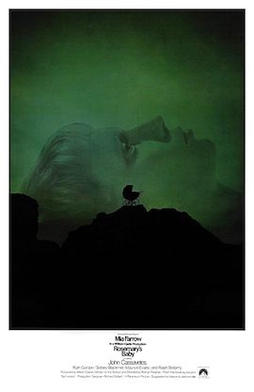
Roman Polanski, 1968 (suom. "Rosemaryn painajainen")
This film is the psychological thriller. Up to the very last moment the viewer needs to balance between if the plot events depict reality or the protagonist's delusions resulting from her weak self-esteem and natural fears during pregnancy. The film relies so heavily on plot that that part cannot really be analyzed without producing spoilers. But I must say that every viewing has revealed to me more details about the characters and events - the film opens up with multiple viewings. I find every character superbly written and every role superbly acted; the film is filled with characters that are totally bizarre yet not surreal (like in e.g. Kubrick films) but totally realistic, and the plot totally explains and justifies their bizarre nature. And the character details follow the plot in a highly subtle manner which is best visible on later viewings rather than the first.
The protagonist, by Mia Farrow, is a fragile and dreamy character easily dominated by her stereotypically egoistic actor husband, which is a fairly common and therefore realistic personality combination for a (first) couple. They both strive to live a shared dream of romance and success, but the man's frustration and disappointment about his career is constantly present in his superficial energy and prominent sarcasm (only in the earlier part of the film - this changes sharply in the middle of the film). The supporting actress playing Minnie Castevet won an Oscar and with every reason: a nosy and captivating yet intruding character with a repugnant voice and with every aspect of her having an artificial element. In every scene she wears screaming clothes that are not out of this world but just expressing unbelievably bad taste. Her husband, Roman, is extremely socially apt, pleasant and intense with "pierced ears and piercing eyes". The nicest and most lovable couple that just has something thoroughly awkward about them. And talk about their friends!
The film's dream scenes are wonderful...the best "dreams on film" I've seen. The dreams depict heavy symbolism, archetypical roles like nuns, priests and sea captains, voices of people from the past day on different characters, and faces of people from the past day in different roles. And being the dreams of the film's self-suppressing protagonist, there is an element of submission.. I especially liked when she, before the central nightmare rape of the film, in her dream says: "Please don't change the program on my account". The music is superb: there's free jazz depicting confusion (similarly to 'Repulsion' by Polanski) and very effective howling "snake-like" tunes in the nightmarish scenes that are genuinely dreadful.
The horror element in the film builds upon women's subconscious fears during pregnancy in a highly effective manner that by no means gets limited to female audience. This could not have been reached without an exceptionally great combination of story, direction and acting.
keskiviikko 16. syyskuuta 2009
High Noon

Fred Zinnemann, 1952 (suom. "Sheriffi")
I really enjoyed this film. It's a Western, yes, but concentrates solely on an ethical theme of duty versus personal asset through dramatic exacerbation, very similarly to many Kurosawa classics. The protagonist town sheriff learns on both his wedding day and a day of his planned retirement that a dangerous convict has been pardoned and is approaching the town in menace with his criminal gang (on a train that will arrive at high noon). The whole town loving and appreciating him to the extreme, in addition to his wife, use everything in their arsenal - including his wife threatening to leave him - to make him forget about this event and choose in favor of his own good. Yet, while driving away on his honeymoon in his cart, he turns back and returns to his duties (it is his last day, are they his duties anymore or are they not?), even turning his back to his newly wedded wife. He tries to desperately assemble deputies but finds this a bit difficult, as men who otherwise have shown loyalty show less courage in the face of a real danger. The film contains many profound moments along with the meeting of the sheriff's new wife and ex-lover and the resolution of his cowardly deputy sheriff trying to escape his personal demons in his struggle between right and wrong. A well-directed and enjoyable film that makes you ponder about right and wrong without trying to underline a right answer. There's a very nice comical scene in how the reverend ends his speech when the city is assembled in the church to decide what is the right decision to make for the good of the whole town.
Modern Times

Charles Chaplin, 1936, (suom. "Nykyaika")
This is my favorite from Chaplin and in my liking the masterpiece of the black-and-white comedy era. Then again, comparing any Chaplin film to any Marx brothers or Buster Keaton film is like comparing any Leone Western to any John Wayne one. Both can be epic, historical, innovative and well-directed, but the latter one lacks something in comparison - exactly like a party can be fun in the sense that there was all kinds of crazy stuff going on that is funny to you 'cos you finally manage to sneak out to a party from an overly protective father that you stand 'cos he sits on top of the family money chest you want to get your hands into someday, or it can be fun in a sense that people were enjoying a moment of liberty from the accepted norms of society in the form of expressing their genuine selves in a warm environment. What I think gave Chaplin's comedies a distinctive character was the bold political stance for the sake of good, a strong leftist message, and to appeal to the poor takes a big amount of humility instead of just technical or linguistic wit. His trademark tramp was a very exceptionally lovable character and therefore had an unusually broad comical repertoire with universal human appeal. The tramp would accidentally drift into his dreams every now and then, dancing around shining like the sun... now, how many comedy characters can genuinely reach that human side (outside Homer who is the main ingredient in the extraordinary popularity of The Simpsons)? Then again, love, or at least showing loving or lovable emotions, is not everyone's treat, but then again, the vast majority of the world, and the consensus of scholars dealing with the topic of healthy emotional and social life, seem to see something important in it.
Chaplin's characters and themes were chosen defending the rights of the oppressed and less fortunate, and, the way I see it, is that his films contained (in Kierkegaardian terms) a lot of humor targeting contemporary social phenomena, as opposed to mere irony or sarcasm. In Kierkegaard's hierarchy of existential levels, a capability of humor is the final stage after a capability of first sarcasm and then irony. To try and express this in an understandable way (that Kierkegaard always isn't to the best extent), humor contains a certain element of dealing with something that one wouldn't want to accept otherwise, and the humorous approach actually is a part of the possibility of accepting it. For example "Modern Times" targets the prevalent negative outcomes of industrialization: poor treatment of workers, crazy new machines replacing human labor, poor people being mistreated while trying to survive in the middle of the industrializing society, demonstrations being dispersed by the police by imprisonment of their leaders et cetera. These phenomena were the negative face of a change in society that was inevitable, and showing all this in the light of humor made it easier for everyone to deal with. Thus his work was a work of genius with an ethical motive underneath, not just the motive of a clown making people laugh in order to put food on his table.
keskiviikko 9. syyskuuta 2009
This is Spinal Tap
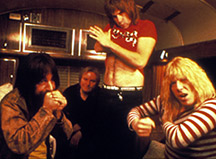
Rob Reiner, 1984
Certainly one of the best comedies - if not the best - ever made. Such a clever and sharp-witted satire of hard rock ("hair metal") and the legends around the bands that a non-expecting viewer may well take most of this fake documentary for real. Every scene is a classic. Superb acting; there's not a single moment in which it would actually look like acting, it's so real... although one must note that the characters are quite average Joes with no substantial acting challenge. But they perform the jokes in such a sincere and realistic manner, and the jokes don't play on typical comedy material but every joke is on Spinal Tap, a "legendary" band formed out of the sad union of vanity and infantility. The film takes multiple viewings to get all the jokes because they are layered in in a very subtle manner. To write this kind of material one must really be in on and love the world of rock. Special points go to 1. the fact that the actors both wrote and performed the various Spinal Tap songs in the film, and 2. the actor playing the bassist, Harry Shearer, being the voice behind a multitude of The Simpsons characters.
sunnuntai 6. syyskuuta 2009
Five Easy Pieces
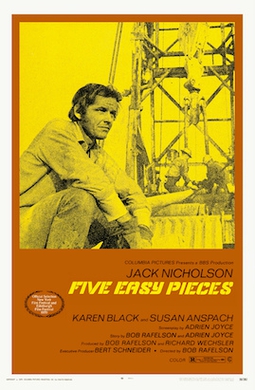
Bob Rafelson, 1970 (suom. "Rajut kuviot")
This was a total surprise... such a great and subtle film and such a role from Jack Nicholson! This is definitely his best role I've ever seen; I didn't know he had such emotional acting capabilities too in addition to his trademark portrayal of a woman-despising self-centered prick. He plays a similar role in this film too, but his dark personality is the whole essence of this film, exploring what makes a man like that: emotionless and controlled although capable of acting emotion, constantly sarcastic, and leading an unhealthy lifestyle rather constantly escaping imminent trouble. He has a relationship with a bimbo that he despises and cheats on, and she keeps him entangled with guilt and suicidal threats. The only thing he loves about her is her lovely singing voice, since he is a run-off from a pure upper class family of musicians, and also an adept pianist. He ends up in a fight with practically every person he talks to and likes making fun of people's disabilities. The climax of the film him meeting with his father was just pure wonderful... so subtle and so very sad. It touched me very much.
The camerawork in the film is lovely and every scene was shot in a way that really captured my interest throughout the film. Maybe it's the choice of clothes, colors, camera views and so on. The second half of the film is filled with classical piano pieces in the background - not as background music but because the scenes are set in a house full of practicing musicians. Also all the acting was superb all throughout the film.
Easy Rider
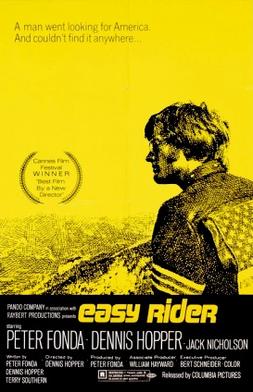
Dennis Hopper, 1969 (suom. "Easy Rider - matkalla")
This film is not just about good music, beautiful American landscape, peace, freedom, dope and motorbikes. It is also quite philosophical about the hippie age, the tension between the counterculture and the mainstream, and the values inherent in the hippie culture. The character played by Peter Fonda is classically ethical (regarding his values - which takes to forget he is smuggling dope money) yet enigmatic: he's not actually enjoying his freedom but rather sincerely searching for it. The conclusion he comes to in the end of the film, I think, is borrowed from the final conclusion in Seven Samurai. There are many lines of dialogue with a deep aspect to it, such as the explanation of the difference between being free and speaking about freedom, told by the character played by Nicholson.
maanantai 3. elokuuta 2009
Dersu Uzala

Akira Kurosawa, 1975
Again I sit in pure amazement watching Kurosawa's work. He can take any (film-wise) traditionally uninteresting character, like Dersu in this film or the grey government official in "Ikiru" and use his magic to make them interesting and beautiful with all the respect for life and goodness. The film had several moments in which some part of the plot is merely hinted at by the reactions of the characters, but left unsaid by the film because there's no need to mention them. Every scene is very beautiful, showing the Siberian nature in its purest. The main character Dersu is wonderfully played.. very emotionally intense yet totally out-of-this-world. It is an inspiring yet sad tale, based on a true story, of a man who has chosen a nomadic hunter life in the Siberian wilds and has completely spiritually integrated with nature living off it with profound humility. And it is a tale of the wordless yet deep friendship between him and the other protagonist, a Russian scout captain. It is an unbelievably beautiful film with a unique subject in film shot in a unique environmental setup.
perjantai 24. heinäkuuta 2009
Aliens

James Cameron, 1986 (suom. "Aliens - paluu")
One of the very few movie sequels that can make it work. Just like "Godfather part II", the theme stays the same but the directional style (and in this case also the director) needs to change. Whereas "Alien" is a slow, creeping, atmospheric horror thriller, this film is a pure action film that gets the benefit of using the wonderful monster, or this time rather a whole lair full of them. The visual and sound effects, like in the prequel, are highly innovative and contribute to an awesome sci-fi experience. Sigourney Weaver in the lead role is most excellent, I think even better than in the prequel. The action is very intense and keeps the viewer pinned down all the way throughout the film. The moment in the end of the film when the android Bishop gets pierced is one of my all-time favorites for the surprise moment and the sound effect he makes! The film is filled with wonderful sci-fi innovations and a revolutionary inspiration for all sci-fi action to come.
OK, the "Star Wars" trilogy has lots of wonderful elements in it and was my special favorite as a kid, but watching it now as a grown-up there's a thick layer of plastic all over it (and the new prequels just testify George Lucas' true nature all along). The human voice of C3PO having comical discussions with R2D2, the shiny-eyed Mark Hamill as Luke, the father-like Obi-Wan and Yoda... all the characters, despite being alien, are way too familiar human from a dramatic point of view to produce a sense of realism; not to mention the plot of each of the films, crafted to the max in Hollywood-style to appeal to everyone. The Mos Eisley bar joint in "Episode IV: The New Hope" is actually playing jazz, which is a style of our real music with black American roots, for Christ's sakes! The film doesn't lift a finger to take its viewer for serious. There's also been much wahoo about the originality of the film's special effects... okay, the light sabres are quite an innovation, but the space flight scenes in 3D have been made over 10 years before in 2001: A Space Odyssey (which would appear on this list if I didn't for some personal reason dislike Kubrick).
Not for "Aliens": the harsh language of the space marines, the brutal nature of the monster consisting solely of features countering human empathy... all the elements in the film really give you a sensation of being among the killing wipeout-mission the marines are sent in for (war really is no playground), rather than the comfort of reliving your childhood dreams among an imagination inspiring discovery fantasy. The reality depicted in the film just is out there without any underlining and making a big number out of all the small sci-fi innovations and the viewer can rather just take a look at it for himself, but in the end what lies there to be found is something so horrible one doesn't even want to see it but cannot help having to witness it. The sounds are terrifying, the world of color is dark, blue and sinister, and everything about the film is just about waiting for something very terrible to emerge out. That is what makes "Aliens" a great film.
Alien

Ridley Scott, 1979 (suom. "Alien - kahdeksas matkustaja")
Everyone's seen this film or its sequel, but it' still great. The term 'alien' entered common use generally meaning a monster from outer space from this film. Quite a cast of great actors for a horror film, one must say, and they're great! Weaver as the action woman is one of a kind and the other woman (Veronica Cartwright) does a great job sobbing and screaming in pure horror and despair when they realize they are being hunted without a chance to run. Such an atmosphere with the sounds of the spacecraft and running water (key element also in Blade Runner; lessons learned from Kurosawa?), waiting in the silence for the monster to attack. And what a monster! The greatest movie monster of all time in (quite literally) getting under your skin. The monster that kills horribly and beautifully. Probably the greatest inside-a-spacecraft film around in terms of atmosphere. The android white blood is ingenious.
torstai 23. heinäkuuta 2009
Cool Hand Luke

Stuart Rosenberg, 1967 (suom. "Lannistumaton Luke")
This film manages to touch with its protagonist that has difficulties living with the rules of the society. He's not your average shoplifter, though, but displays strong character, albeit gets himself imprisoned for no real reason on a drunken night apparently just for the sake of lack of purpose. It is mentioned that he had served in the war, so his tragedy portrays the difficulties a lot of Vietnam veterans experienced after returning from the highly unpopular war into the middle of hatred from their fellow men (the same theme underlies John Rambo's story in "First Blood" albeit that film didn't really get famous only for it's sympathetic anti-war message). Funny thing is, I learned after the film that the main supporting character (played by Ed from The Naked Gun), who kept bothering me throughout the film for his questionable acting, actually won a supporting actor Oscar from this film. And Paul Newman with his wonderful rendition of "Plastic Jesus" got only nominated.
sunnuntai 19. heinäkuuta 2009
Scarface

Brian De Palma, 1983 (suom. "Scarface - arpinaama")
This film, despite carrying none of the pure artistic content of "The Godfather" and its sequel (those being the unavoidable first films of comparison), somehow manages to be very entertaining and memorable. Maybe it's just Al Pacino's role, which I think is the best role he's ever done (being even more breathtaking than the role of Michael Corleone due to the Cuban attitude and accent), or maybe it's the story of what happens when a pure dog without a family gets too much power; maybe it's just the world of crime and violence with the 80's pop beat on the background, or maybe it's a borrowed continuation of awe carrying over with Pacino from Godfather - I really don't know. There's a lot of cool one-liners in the film and a lot of memorable yet somehow unartistic moments. The film also has a very plain and difficult-to-miss storytelling. But somehow is just pure enjoyment to watch, time after another.
p.s. I really think it's the Pacino's role!
Way of the Dragon

Bruce Lee, 1972
I chose this instead of "Enter the Dragon" for my one Bruce Lee entry, although that one is quite equally good. These films are not really in the plot elite: someone bad does something bad to a relative of Bruce Lee's character, then he is summoned to take care of the bad guys (or swears revenge or something similar). And this he does in his own particular idiom; always a totally humble, nice and rather reserved character socially, yet when the situation calls, turns into an otherworldly cat-like screaming killing machine that delivers even his final killing blows with an expression on his face as if he was something like eating the soul of his victim. In the end there's a final showdown with the boss meanie.
Jackie Chan films can be flashy but any greatness is lost under the continuous experience that one is watching cleverly directed martial arts choreography. Not with Bruce Lee; his films, despite displaying amazing martial arts stunts, aim for realism. Let it be known for people unfamiliar with him particularly that Bruce Lee was a martial arts super-legend for real; challenged by numerous people throughout his famed career and always totally sovereign and unbeatable. He just so happened to be welcomed into Hong Kong martial arts film industry due to his legendary skills. He developed and taught his own martial arts technique and the related philosophy.
This film, like Bruce Lee films in general, are great just for seeing the physical extreme a human can be capable of (a couple of spoilers here won't matter since the plot in the film plays no role). Once his friends want him to show how hard he can kick, and when the kick lands on the training mattress held by a friend (obviously in a proper manner supporting it with all his weight), the man along with the mattress are projectiled several meters backwards, landing on pile of cardboard; quite similarly as if he had been hit by a car. Once he jump-kicks a lamp in the ceiling just to scare off his readily scared opponent without having to crush him. This film contains a wonderful final scene with Lee fighting Chuck Norris in the Colosseum in Rome, picturing the fight and a small kitten going about his business side by side. Lee's physical fitness, as seen in this film, is generally considered historical and has reportedly been a major inspiration for bodybuilders.
perjantai 17. heinäkuuta 2009
Gandhi
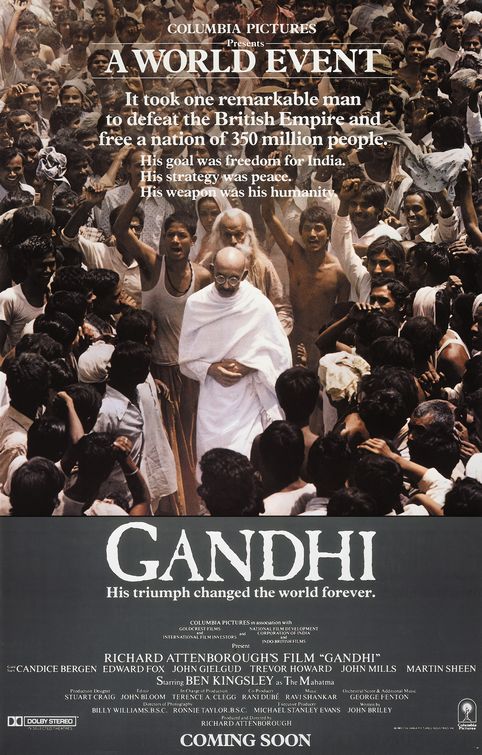
Richard Attenborough, 1982
This is a film that makes one wonder of a great deal of things. First of all, it is a very fine passageway to Indian philosophy and spirituality through the story of their spiritual father and national liberator. Secondly it is a beautiful film. Thirdly it gives much to think about spirituality and politics. Ben Kingsley surely is a demi-god for Indian people after his unimaginably well acted role in the film; I think there's no other actor in the world capable for the role with real professional acting skill and the potential to correctly perform Gandhi's constant compassionate smile. However, I only learned quite recently Ben Kingsley actually is of Indian descent, which makes his performance easier to deal with.
Christian fundamentalists please look away, but I have often compared Gandhi to Jesus Christ as first and foremost a spiritual leader that achieved the unification of people oppressed by superior power yet chaotically segregated into mutually hostile spiritual communities. Such poor, uneducated and spiritual people don't have trust for politicians but will only truly listen to and follow someone speaking their own spiritual-religious language. Gandhi, like Jesus, knew very well he was to be punished (imprisoned) by the oppressor, yet the Imperial Roman punishment (death by torture) just was harsher than later Imperial British. The symbol Christians all over the world today bow to essentially depicts the symbol of superior political power (torture device) over oppressed yet spiritually unified people.
Allegro Non Troppo
Bruno Bozzetto, 1977
This is something I watched many times as a kid and loved it. Now that I watch this wonderful unification of classical music and animation again as an adult; well, it is just great!
The film is not very well known for some reason and Wikipedia calls it a parody of Disney's "Fantasia". But I hardly find it comical to any extent. It features several beautiful classical pieces superimposed with most imaginative and beautiful animation. Among the six pieces one can hear "Prélude à l'après-midi d'un faune" by Debussy, "Bolero" by Ravel and "Valse Triste" from Sibelius. In between of the animated pieces there's a black-and-white shot comedy storyline of an orchestra comprising of old grannies forced to cowork with an artistic animation painter by a tyrant producer that let them all out of their prison cells for production. I find these intermittent parts somewhat uninteresting; the whole thrill of this film is in the animated parts.
This is a film that you want to have your children watch, no matter if you enjoy classical music yourself or not. The animation is very high quality, artistic, sensitive, imaginative and guaranteed to appeal to people of all ages, and I find the film above all educating as an easy gateway to beautiful classical music for children, since children generally are easily grasped by animation. I watched this with my then-girlfriend's girls (aged 4 and 9) and they totally loved it and wanted to watch it all the time, yet were for the first times a bit shocked because two of the animated pieces have very sad themes (to the extent of bringing a sensitive adult to tears too). The older girl cried and the younger one was really unsettled and worried for a long time after watching it "because the cat (in 'Valse Triste') will have no home". So both had a very strong emotional response, but I find this the best possible way for children to experience sad emotions in a warm, safe and shared environment, and will surely help them develop emotionally balanced. Not to mention how good it is for children to hear lots of classical music during growing up.
"Valse Triste" from Sibelius (our national hero) has left a special imprint on my heart due to this film, and the version happens - in my liking - to be the best conducted one (by von Karajan) from the many versions I've heard. I happen to know from Sibelius' biography that the piece has originally been composed based on a certain painting by Akseli Gallén-Kallela, to a wholly different visual theme depicting the last waltz of a dying old woman before death. However, the feline animation in this film succeeds perfectly in doing justice to the emotional components of the piece, which was left one of the best known (and the easiest to approach) work by Sibelius.
Monty Python and the Holy Grail
Terry Gilliam and Terry Jones, 1975 (suom. "Monty Pythonin hullu maailma")
Comedy doesn't get much wilder and better than this... this comedy is for the witty out there. I've noticed the film is particularly appreciated among "nerds", and this is obvious... behind all the Pythonian absurdity there's a large amount of intelligent and philosophical jokes addressing e.g. idealistic differences between a monarchy and anarcho-syndicalism and if a carved inscription on the wall reading "Castle Aaaaaaarrrggghhh..." is a result of a man dying while carving the inscription. Monty Python's "Life of Brian" is generally very highly appreciated but for some reason I find it rather dull since its theme of attacking biblical themes doesn't really shock me in itself. But about every single scene in "The Holy Grail" is an immortal classic... and this is due to the wit and darkness of the humor, not due to them attacking any particular sacred subject.
Comedy doesn't get much wilder and better than this... this comedy is for the witty out there. I've noticed the film is particularly appreciated among "nerds", and this is obvious... behind all the Pythonian absurdity there's a large amount of intelligent and philosophical jokes addressing e.g. idealistic differences between a monarchy and anarcho-syndicalism and if a carved inscription on the wall reading "Castle Aaaaaaarrrggghhh..." is a result of a man dying while carving the inscription. Monty Python's "Life of Brian" is generally very highly appreciated but for some reason I find it rather dull since its theme of attacking biblical themes doesn't really shock me in itself. But about every single scene in "The Holy Grail" is an immortal classic... and this is due to the wit and darkness of the humor, not due to them attacking any particular sacred subject.
The Simpsons Movie
David Silverman, 2007
Ok, I am a huge fan of The Simpsons TV series and find it the only series worth bothering to really watch whenever possible (after "The Ren and Stimpy Show" is gone), and recently I've gotten really into it because I've started to appreciate it above the normal "I just love this series" level. The humor in The Simpsons is just great, not only because their large number of writers, great voice acting and so... but rather for their unrestricted policy of attacking with satire every single human or society-level feature. This goes beyond the limits of normal comedy and the evolution of the characters in the series has had exactly enough freedom not to stay repeating old models but experimenting with different artistic styles. I think The Simpsons have achieved something very unique and great in comedy and TV history.
I had a very low expectation of The Simpsons Movie when it premiered due to the episode of declining quality of the TV series, but the film just totally destroyed this image and proved the potency of the series to break old barriers and "go nuts". Homer, who has been in focus for a long time in the TV series, was given totally new qualities of darkness displaying a new kind of infantile-like behaviour going all the way down to wondering whether he and his pet pig should kiss. It's as if the character was on LSD... so dark and crazy, yet when Homer says it the way he does, it's just killer funny.
Ok, I am a huge fan of The Simpsons TV series and find it the only series worth bothering to really watch whenever possible (after "The Ren and Stimpy Show" is gone), and recently I've gotten really into it because I've started to appreciate it above the normal "I just love this series" level. The humor in The Simpsons is just great, not only because their large number of writers, great voice acting and so... but rather for their unrestricted policy of attacking with satire every single human or society-level feature. This goes beyond the limits of normal comedy and the evolution of the characters in the series has had exactly enough freedom not to stay repeating old models but experimenting with different artistic styles. I think The Simpsons have achieved something very unique and great in comedy and TV history.
I had a very low expectation of The Simpsons Movie when it premiered due to the episode of declining quality of the TV series, but the film just totally destroyed this image and proved the potency of the series to break old barriers and "go nuts". Homer, who has been in focus for a long time in the TV series, was given totally new qualities of darkness displaying a new kind of infantile-like behaviour going all the way down to wondering whether he and his pet pig should kiss. It's as if the character was on LSD... so dark and crazy, yet when Homer says it the way he does, it's just killer funny.
The Texas Chainsaw Massacre

Tobe Hooper, 1974 (suom. "Teksasin moottorisahamurhat")
This is a very effective horror movie that despite its gory name is actually eventually not so gory in the sense of displayed gore. Just the extremely brutal subject and the all-present mindless violence in the film is enough to keep the viewer on his toes throughout. What could be a more terrible thing to imagine than a human leather masked bloody apron wearing mindless maniac chasing you through a thicket in the middle of almost total darkness of the night, wielding a running chainsaw? Many scenes in the film really got under my skin due to their pure experienced (not displayed) brutality.
About horror films in general please read my post on "Suspiria".
torstai 16. heinäkuuta 2009
One Flew Over the Cuckoo's Nest

Milos Forman, 1975 (suom. "Yksi lensi yli käenpesän")
The silly thing about this great film is (as I've read) that the title of the film was available to be understood from the original novel but not in the film (it was a part of a children's poem displayed in the novel). The scene in which the patients are going fishing and presented as scientists is simply ingenious, as is the scene in which the patients return from their fishing trip, posing with their catch ready for a big nice open-armed welcome. I liked Christopher Lloyd's performance as the agitator. Also the mental institution dance scene is wonderful.
The Adventures of Robin Hood

Michael Curtiz and William Kneighley, 1938 (suom. "Robin Hoodin seikkailut")
This is a film I watched ever so many times as a kid and I just loved it. When I watch it now as an adult: ok, it is quite a "Hollywood" film with good acting and good spirit... but the music! The music just sends chills down my spine, especially the march before Prince John's to-be-failed coronation (and especially a certain part in which the chords suddenly modulate and the main theme viola makes a crazy jump a ninth higher and then comes down chromatically...). I've found myself whistling or humming to the tunes of this film tens of times as an adult... and now that I can read that the film won an Oscar for its music I'm not really surprised at simply justice having taken place. Claude Rains (Prince John) for some reason always does it for me, no matter which of his evil cunning aristocrat roles (such as in Casablanca or Lawrence of Arabia) we might speak of.
Casablanca
Michael Curtiz, 1942
I'm generally not one for romantic love stories, but Casablanca is much more than that; it is a film depicting human nature and life very deep down. Such a plot, such an ultra-fast pace of storytelling, such great acting... I particularly love Claude Rains as the charming Captain Renault. I think the film has one of the best film endings ever made: the twist of plot was so unpredictable yet so meaningful and understandable. How two important figures can be formal enemies but smart businessmen whenever a chance for common business arises. The character played by Bogart, a smart, witty, outspoken, brave, ethical and capable man, had turned from a resistance-fighter into a highly successful yet cynical casino-runner by utter disappointment in love... such a larger-than-life story. The hatred Rick displays towards Ilsa when meeting her is wonderfully written.
I'm generally not one for romantic love stories, but Casablanca is much more than that; it is a film depicting human nature and life very deep down. Such a plot, such an ultra-fast pace of storytelling, such great acting... I particularly love Claude Rains as the charming Captain Renault. I think the film has one of the best film endings ever made: the twist of plot was so unpredictable yet so meaningful and understandable. How two important figures can be formal enemies but smart businessmen whenever a chance for common business arises. The character played by Bogart, a smart, witty, outspoken, brave, ethical and capable man, had turned from a resistance-fighter into a highly successful yet cynical casino-runner by utter disappointment in love... such a larger-than-life story. The hatred Rick displays towards Ilsa when meeting her is wonderfully written.
The Godfather Part II
Francis Ford Coppola, 1974 (suom. "Kummisetä, osa II")
The sequel to "The Godfather" continues the Corleone family saga (and shows events in the main characters' common childhood) with a somewhat different way of storytelling. The film displays its plot partly in such a subtle manner I think it took me about 5 viewings to cover the holes in the patchwork, especially regarding Fredo's and Hyman Roth's activities in Havana. A heartbreaker for me was the fact that earlier in the film poor Fredo was telling a child that whenever he used to go fishing as a child he would recite Hail Mary which would help him catch fish (which is a manner of inspiring children of religious themes) yet in the end of the film when unexpecting Fredo is out on the lake fishing (without any children around) he is actually still reciting Hail Mary. This means that he was still left a child at heart and never grew up to participate in the family business.
The sequel to "The Godfather" continues the Corleone family saga (and shows events in the main characters' common childhood) with a somewhat different way of storytelling. The film displays its plot partly in such a subtle manner I think it took me about 5 viewings to cover the holes in the patchwork, especially regarding Fredo's and Hyman Roth's activities in Havana. A heartbreaker for me was the fact that earlier in the film poor Fredo was telling a child that whenever he used to go fishing as a child he would recite Hail Mary which would help him catch fish (which is a manner of inspiring children of religious themes) yet in the end of the film when unexpecting Fredo is out on the lake fishing (without any children around) he is actually still reciting Hail Mary. This means that he was still left a child at heart and never grew up to participate in the family business.
The Godfather

Francis Ford Coppola, 1972 (suom. "Kummisetä")
One doesn't need to particularly explain why the film generally reviewed as the greatest (American) film ever made is what it is. The Godfather is pure and terrible beauty; perfect in every aspect. One can just sit down time after another and watch it, getting immersed into a romantically portrayed world of unimaginable crime and human cruelty, and at the same time know that the world being shown is a part of American unspoken political reality. One can watch it and think about politics; one can watch it and think about the human nature; one can watch it and think about love and family; one can watch it and think about acting or directing... it gives one something to think about whatever one happens to be in need of.
Lawrence of Arabia

David Lean, 1962 (suom. "Arabian Lawrence")
The exceptional greatness of this film is the character of the main protagonist, no matter how realistically he models the real T. E. Lawrence. He is enigmatic and philosophical and his character is quite the opposite that one is accustomed to witness in historical films of this type. I think Peter O'Toole succeeds wonderfully and the film wouldn't have made any special impression on me had it been acted differently. It truly makes one wonder what it takes from a man to be able to perform truly great deeds; being able to genuinely (without force) win the trust of a totally alien and hostile culture as their leader, and to actually unify warring tribes under the same flag.
The Elephant Man
David Lynch, 1980 (suom. "Elefanttimies")
This film is surely one of the greatest eye-drainers ever made for the empathetic out there. Reading about it, I've noticed many people touched by the theme of human cruelty towards a different individual. What I found the most touching was the fate of a sensitive and purely good-hearted individual having it impossible to live in society at all. The (voice) acting of John Hurt touched me deeply and my great favorite Anthony Hopkins makes a truly wonderful role too with his ethical struggle: is he one of the curious viewers (bad people) too having actively presented the Elephant Man to the medical society? He is genuinely empathetic yet still an intelligent expert in his role, and thus needs to stay somewhat emotionally distant from the Elephant Man. The ending was actually quite predictable (what else could it all lead to?) yet Barber's Adagio is, simply put, heart-crushing. Despite not being a general fan of Lynchian dreamy scenes, the very final scene with the words of the Elephant Man's mother echoing in the air with the last tones of Adagio ringing in the background... it is just one of the most beautiful movie moments I have ever witnessed. In my experience, the words the mother utters turn into poetic expression because all meaningful words have been used and nothing can be said anymore yet the emotion just lasts.
By the way, I once read a very funny e-post from someone about this film; he said something like: "What is this s**t?!? I've seen Spiderman, Superman, Batman... but 'Elephant Man'?? Get out of here!"
tiistai 14. heinäkuuta 2009
Das Boot
Wolfgang Petersen, 1981 (suom. "Sukellusvene U-96")
This film is quite thoroughly praised all around so I'll rather skip that. What I remarked, however, was the same effect that Seven Samurai had when we once watched this film with my then-girlfriend's girls, aged 4, 9 and 11. We watched the whole director's cut in a single session, and although this might sound like a parental crime: not once during the 5 hours (of a German-spoken war film directed inside a single submarine) was me nor any of the girls bored or tired but kept following the plot and the greatly depicted characters intensely and talking about the characters and the events in the film (only the very end we skipped with the girls and concluded with "...and they all lived happily ever after"). I take this as a quite clear sign that there's something very very special in the direction and/or acting: the set-up qualifies the criteria of eternal boredom but the result is the opposite... for viewers of any age.
Note: someone might raise an upbringing concern about the suitability of the language in such a film for children, but I don't see girls copying any German curse words and they will learn to curse in Finnish well enough in junior high.
Ringu
a.k.a. "The Ring", Hideo Nakata, 1998
First of all, if you haven't watched this nor the American "The Ring" (2002), please 1. don't read plot spoilers (there are none here) and 2. don't watch the American one but this one instead. There is no other way to describe it accurately except that the Americans took a pure masterpiece and it's popularity and turned it into a meaningless nothing. The fact that upon its release this film became the highest grossing film in Japan should be seen as a hint for its appeal.
This is the horror film that sent me, a blood-stained horror film veteran, to nights and months of scary imagery. As the veteran I am, I just casually watched it alone at 1 a.m. with my then-girlfriend sleeping next to me. I was left unsettled and scared to go to sleep; but much more: the unimaginably effective audio and imagery in the film just carried on in my mind for a long time. I had to watch it a couple of times again to better be able to deal with it.
The film relies on plot (of which I will reveal nothing here) and very fine use of color, sound and direction. There's no blood or gore, no knife-wielding maniacs, no "cheap spooks", no computer special effects, just something very original and a result that you don't want your young children to watch. I was simply left in awe after seeing the film admiring how well it is actually built... this is something a B-movie director can''t achieve by just throwing in scary looking monsters, blood, torture, loud spooks etc. but requires a real artist just to direct, and I urge any people to watch it who generally classify horror films as B-films. The film uses a somewhat similar and very unsettling metallic sound approach I heard before on The Texas Chainsaw Massacre (which was actually rather rock-drill sounding).
A part of the appeal of this film for me was my former unfamiliarity with Japanese horror in general, which I have learned to have quite a different tradition from us. But you can simply forget about the sequels for this film (I had to check just to be sure) or any of the American boom. "Ju-On" ("The Grudge", Takashi Shimizu, 2002) borrows quite a lot from the imagery from this film in an effective manner, but I didn't find it half the killer this film was to me.
About horror films in general please read my post on "Suspiria".
Suspiria

Dario Argento, 1977 (suom. "Suspiria - tappavat huokaukset")
I've watched a couple of other films from Dario Argento after Suspiria and been disappointed; none of them even closely catches the atmosphere Suspiria carries. The color, the sound! I think the real explanation why this film really corroded on my mind is in the loud and highly innovative soundtrack.
Horror films are not everyone's treat and many people argue that they cause nightmares... but in my thinking it is exactly the opposite way around: nightmares are related to our imagination and subconscious mind - that everyone has - and horror films rather provoke us to deal with the subconscious and provide a safe environment for us to have scary experiences. To put it another way, I much rather see nightmares in which I am the viewer/director - which is natural to me being accustomed to watching horror films - than actually living the experience of the horror film victim and becoming genuinely afraid to go to sleep.
A bit more philosophy of horror: we all have the capability for horror experiences in us and actually it is argued in many contexts that our subconscious fear is always the same kind of fear. In order to be able to effectively face one's subconsciously experienced incapabilities (in order to get better) one needs to be able to face that fear. Fear of humiliation is as strong as fear of death deep down; it is just not recognized as such since dying is very concrete compared to fear and also, for social reasons, we are not allowed to show fear without a visible target.
The Good, The Bad and The Ugly

Sergio Leone, 1966 (suom. "Hyvät, pahat ja rumat")
This is a film so beautiful and ingenious in plot and character that there's not actually much to say. There are several profound plot details related to the characters that affected me, such as: Why didn't Blondie get beaten up half-dead by Angel Eyes at the prison camp but Tuco did? Tuco's a pretty great shot too but why was it that Blondie always got to do the shooting and Tuco the hanging in their hang-n'-shoot-n'-run money earning scheme? Tuco is a religious man and his brother is a priest; and he isn't stupid but capable of genuinely outsmarting the ever so smart Blondie early in the film. He gets increasingly genuinely affectionate towards Blondie as the film goes on albeit showing that towards an enemy/rival is not an option; so he wasn't really bad in the sense of evil like Angel Eyes was. Well what was he if he wasn't bad or stupid then? Well, he was just "ugly"!
Once Upon a Time in the West

Sergio Leone, 1968 (suom. "Huuliharppukostaja")
This film, I think, is very underrated - maybe because albeit being a pure masterpiece it is very difficult for someone expecting something different. It is very different in direction from the rest of Leone's other spaghetti and in every sense better than "Once Upon a Time in America" that I find just disappointing. I think I actually understood the details of the plot - to the extent that there are no gaping holes in the patchwork - after my third time watching it. Charles Bronson, the tough guy, gets such a wonderful role in this film as a truly enigmatic hero. The opening scene is such that one can watch it time after another and just absorb the beauty of the directing and listen to the sounds of the windmill. The final climax of this film, that answered the problem of the hero, sent gushes of larger-than-life chills down my spine and left me sitting in pure awe. I think around 70% of the dialogue in the film consists in pure killer single-liners... the coolest thing anyone can say at that point.
Ikiru
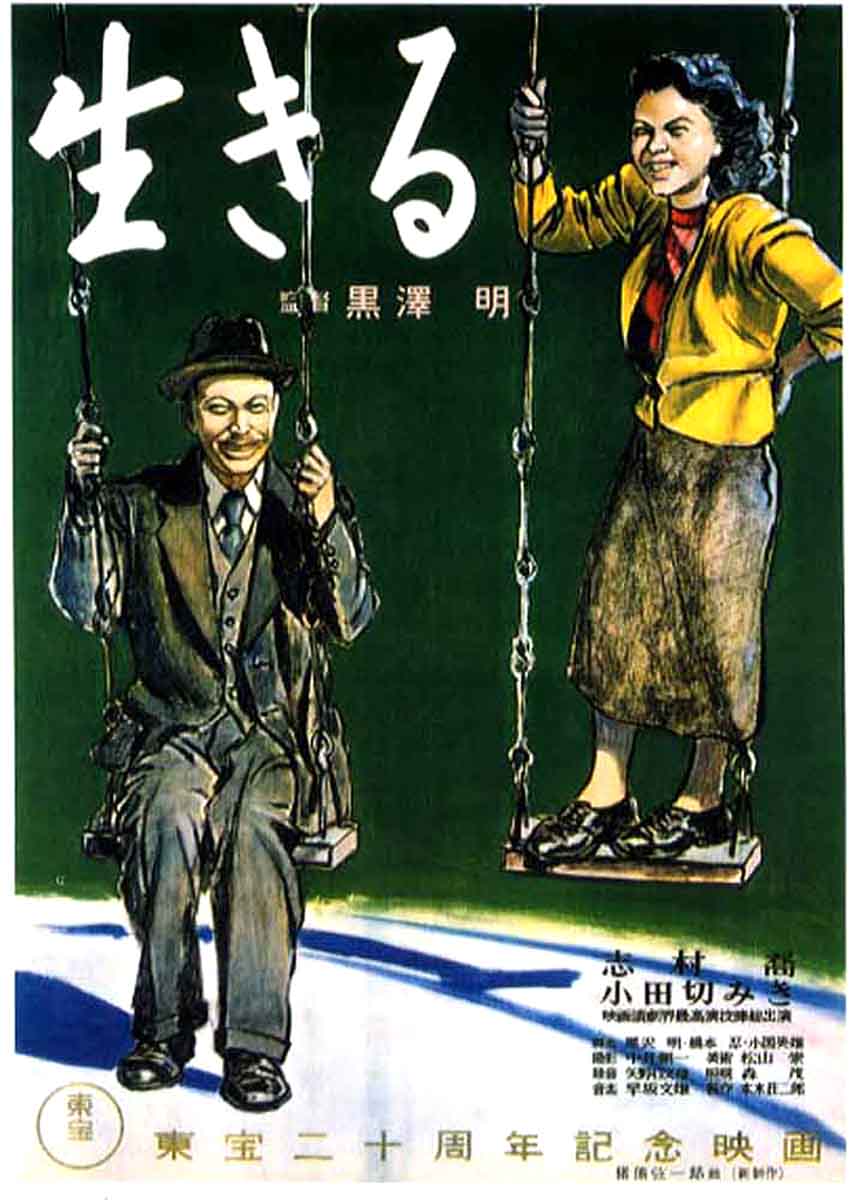
Akira Kurosawa 1952 (Eng. "To Live", suom. "Ikiru - tuomittu")
Such a protagonist for a film! Kurosawa is really great, this film is so wise! The protagonist's resolution was really surprising and profoundly ethical. I remarked the funeral part of the film bearing great resemblance to "12 Angry Men" I've seen before... and a quick check revealed that it had been directed 5 years after; so it's not difficult to tell if some influence has been passed on. The end was even to some extent predictable because of this.
Seven Samurai

Akira Kurosawa 1954 (suom. "Seitsemän samuraita")
Well, one probably cannot praise this film enough and the millions of analyses/PhD theses and so forth made about it should objectively pinpoint why it's so great. What I remarked is that one time we watched the film with my then-girlfriend's girls, aged 4, 9 and 11, and throughout the 3½ hour black-and-white film spoken in Japanese, the girls too were watching intensely, asking questions and laughing at the comical spots. What can one say if someone can make a film in black-and-white and spoken in Japanese in 1954, that has that effect on Western people of all ages 55 years later? I think this film is quite different from the first thing that comes in mind when thinking of Japanese samurai films: it is actually an archetype of a Western action film with lots of action but also comedy and romance, and they say this film to a large extent defined the Western action film as directors started taking influence. But I think Seven Samurai is much more "loving" and concentrating on the personalities of the characters than its Western little brothers. There are no traditional bad guys and a fight against good and evil, but rather a philosophical theme of an ever-lasting battle in which some are winners and some are losers - which is resolved in the very end of the film.
Kurosawa is a master in portraying characters: there are 7 samurai working for a common cause voluntarily, and because of this the viewer needs to ask what makes them willing to risk their lives for this cause and to find out that every one of the samurai have different reasons. This is done without any underlining of the topic but simply displaying the characters, yet it is done knowingly and precisely and it results in the viewer loving all the samurai. I just love the character Kikuchiyo... such an anti-heroic bully but so important in the samurais' common effort, not just for his comical relief for the viewer.
Tokyo Story

Yasujiro Ozu, 1953 (suom. "Ensimmäinen matka")
A total surprise: after wiping tears many times during the film, after the film I had to ask myself what just had happened. I think this kind of a film can only be made in Japan. A normal family is pictured in a calm and simple way, but the emotional story-telling, that is in focus, happens behind the lines which occurs in the perfect setup of Japanese traditional parents; they do not say aloud what they think but the viewer needs to know this based on their actions and the actions of others. The actor performances were as good as they can ever get.
Tilaa:
Kommentit (Atom)