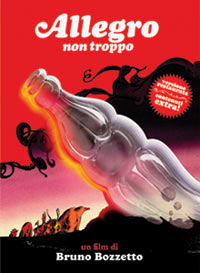
Bruno Bozzetto, 1977
This is something I watched many times as a kid and loved it. Now that I watch this wonderful unification of classical music and animation again as an adult; well, it is just great!
The film is not very well known for some reason and Wikipedia calls it a parody of Disney's "Fantasia". But I hardly find it comical to any extent. It features several beautiful classical pieces superimposed with most imaginative and beautiful animation. Among the six pieces one can hear "Prélude à l'après-midi d'un faune" by Debussy, "Bolero" by Ravel and "Valse Triste" from Sibelius. In between of the animated pieces there's a black-and-white shot comedy storyline of an orchestra comprising of old grannies forced to cowork with an artistic animation painter by a tyrant producer that let them all out of their prison cells for production. I find these intermittent parts somewhat uninteresting; the whole thrill of this film is in the animated parts.
This is a film that you want to have your children watch, no matter if you enjoy classical music yourself or not. The animation is very high quality, artistic, sensitive, imaginative and guaranteed to appeal to people of all ages, and I find the film above all educating as an easy gateway to beautiful classical music for children, since children generally are easily grasped by animation. I watched this with my then-girlfriend's girls (aged 4 and 9) and they totally loved it and wanted to watch it all the time, yet were for the first times a bit shocked because two of the animated pieces have very sad themes (to the extent of bringing a sensitive adult to tears too). The older girl cried and the younger one was really unsettled and worried for a long time after watching it "because the cat (in 'Valse Triste') will have no home". So both had a very strong emotional response, but I find this the best possible way for children to experience sad emotions in a warm, safe and shared environment, and will surely help them develop emotionally balanced. Not to mention how good it is for children to hear lots of classical music during growing up.
"Valse Triste" from Sibelius (our national hero) has left a special imprint on my heart due to this film, and the version happens - in my liking - to be the best conducted one (by von Karajan) from the many versions I've heard. I happen to know from Sibelius' biography that the piece has originally been composed based on a certain painting by Akseli Gallén-Kallela, to a wholly different visual theme depicting the last waltz of a dying old woman before death. However, the feline animation in this film succeeds perfectly in doing justice to the emotional components of the piece, which was left one of the best known (and the easiest to approach) work by Sibelius.

Ei kommentteja:
Lähetä kommentti